Friday, October 12, 2007

dialogue II, for y.o.


Remember what you wrote about connections? The uncanny coincidences that riddled your days, once in the spring?

I notice that the superintendent of the hospital was
called "Talbot."

Salt process, medical procedure.


I am uncertain about many things, but I maintain (as I am sure you know) a great well of dreams, none to immense to at least offer a concerted attempt at manifestation. Whence this faith in dreams?

(Perhaps this is not true. As I write this I can think of a few, at least, that I am not bold enough, or naïve enough to pursue.) And the days--they are the subjective consequence of the aperture of hope. Lately I am seeing the world through such a tiny opening, hardly any light striking the retina of possibility.

it keeps me up at night.
There‚s a gash in my side
from which sighs leak out
and organize at the foot of the bed.


My friend, I will be forty-two next week. But Doris Lessing has won the Nobel Prize in literature at what, eighty-seven? I am just beginning, no? I see her face, radiant, delighted.

Each day
is a blessing, incredible, exhausting. I take the days
one at a time. Seems to be the best way.

Tuesday, October 9, 2007

commentary on Plath


The Bell Jar: The Journal of Vacuum Technique and Related Topics for the Amateur Investigator

Vacuum Basics: Vacuum Fundamentals, Terminology, Applications, Reading List
The Units of Pressure Measurement (this was exceeded in early October)

Refrigeration Service Vacuum Pumps-Medium Vacuum at Low Cost

Building a Thermocouple Vacuum Gauge (the retainer fee is very high for de-thermocoupling)

A Simple Medium Vacuum System
(is this too much to ask?)

The Radiometer Bob Templeman on Generating X-Rays with Receiving Tubes
Some Resources and Ideas for Plasma Experiments (this may defended with first amendment arguments in some states)


’Vacuum and Scientific Americans Amateur Scientist
Some Recollections - (the postmodern equivalent of recherches des temps perdu)


Infrasound Monitoring with a Microbarograph (the NSA is still doing this)

The Farnsworth/Hirsch Fusor (temporarily bypasses homicidal impulses in rush hour traffic)

Leaks: The Good, the Bad and the Ugly

Bubbles and Gel Candles

Sunday, October 7, 2007

overture to part II


Grace

Walter Benjamin wrote that death is the sanction of everything a storyteller can tell, “suddenly,” he said, “in his expression and looks the unforgettable emerges and imparts to everything that concerned him that authority which even the poorest wretch in dying possesses for the living around him.”

I was born with the gift of touch. My father said it is because she took me into the sky with her when she left, when she rose like Medea in her chariot of the sun, but that he brought me back from the clouds. He carved me out of her belly with a kitchen knife, while her body was still warm, and I was wearing the caul, still tethered to her heart by the umbilicus which he cut, and he breathed his own breath into my lungs. Since then I have heard the stories imprinted in objects, of stones and soil and fabric, all things singing their own history in layers of complex variations like a symphony.

There are fragments of stories I touched as a child, pieces of cloth I stitched together to form a memory of her. The stones I held in my hand as an infant described to me in detail her first steps in that wind-torn field—how the leaning grasses suddenly stilled, awaiting her breath, how the dry wheat shafts were raked by her child’s unselfconscious steps releasing (from the cocked legsprings of tiny, skeletal animals) a sudden volley of sun-refracting flight.

At night the moths told me fairy tales, like shadow plays flickering in the dust of their wings. I held my breath and watched her life unfold before me on my pillow at night like the wings of a cicada emerging from its shell. The dragonflies told me she knew the true names of all the plants and animals, that she understood the language of horses, that she had first learned from birds how to fly.

Before I went to sleep at night, I witnessed as the fields and sky and clouds wrote her stories on my tongue. And as we watched the stars through telescopes before dawn, I would tell them to my father, and he would make me promise never, ever to lift my feet from this earth, not to listen to the beckoning song of the sky, like she had done, but to stay close to the words, for they would anchor me, and this is what I have done.

A key I found in a box possessed the memory of their wedding--how she had opened the door to an old hotel where she had lived as a child, how everything was covered in dust, and there were still toys on the floor that held the imprint of her hands playing with them before the last time she ever walked out that door. The smell of the cedar closet had made her cry, the furs that hung there for so many years still steeped in perfume from a ball, and when I touched the cedar trunk I saw that here she had unfolded the lace of her own mother’s wedding dress, and moths had fluttered out of it like angels. My father had seen their wings reflected in the liquid of her eyes. It was then, he said, that he knew he would not be able to hold on to her.

She married my father in the field of yellow grass behind our house, a shotgun wedding beneath the sky, and the wind whipped around her dress and it billowed such that he thought she might be lifted into the clouds, and the wind took the words, their vows, and carried them to a place where they might never be found. I have always searched for those words. I suspect that they are kept by Aeolus in his cave too soothe the winds.

Before he died my father found the book of poetry she had stolen from his house long ago. He said he knew she had taken it, and he had loved her more for that singular act of necessary thievery than perhaps anything else. I have it now, and use it to remember the sound of the wind that blows differently now that she is gone.

And my mouth still whispers the lyrics to a song about the end, for it is always where my story begins: her tentative steps out into that familiar sun-scorched field, the wedding field, how she walked shedding hope, stepping out of the clinging undergarments of faith, standing naked and pale beneath the light of clouds, clothed only in the heavy weight of a child; how she let go at last the thread that tethered both of us to the incarnate world, that most fragile thread of silk that held her heart to the turning blade, the knife edge, of her corporeal existence, her grief. I touch the earth of the field where she last stood and inhale the familiar smell of the soil, the overabundance of nitrogen, the faint, far off scent of lightning. The metallic particulate of burned gunpowder hovering, later, in the astonished air; the casual way she shrugged off her earthly weight like removing a heavy shroud. And then she was free, fragmented, fleeting upward in a fusion of light and memory, at last unburdened by the density that had pressed her down: this earthward pull, what had brought her here, and me, all of us, longing to experience the fragile beauty of light, the smell of skin, the delirious sensation of taste and touch, and sound.

And now I tell your stories to keep you close to me, until I, too, am safe again in the weightless world, for the stories, as Benjamin said, are like “seeds of grain which have lain for centuries in the chambers of pyramids”—what is germane and vital still, and born again in bread, sustains us. You were, Rilke said, “like bread on the altar before it is changed…”

I tell the stories beginning to end, middle spiraling outward, or from end to the unraveled beginning, where the sky first fell in love with you, a glinting fleck of star, fallen from the infinite heavens, for the first time perceiving within yourself the insistent longing for gravity, not knowing the weight, the sorrow, that was its bane. For the stories remind me of who you once were, and in the telling we are redeemed.
Sunday, September 2, 2007

epilogue to part I


It has taken me a while to process that my search for him is over. I was looking for him through light, through scattered fragments that disintegrated as I touched them, and the found that the only indelible remains were factual and cold, that I had created the past I was searching for, and its reality was as ephemeral as a dream.

We are complex creatures, and there is no tracing (at least at this moment) of our genetic material back through generations, and what if there were? It would no more belong to my grandfather or his father or mother than anyone else, in the alphabet soup that is each of our particular recipe for being. Even that is mutable, and we can raise (or lower) ourselves depending on will, and possibly faith.

When I look at the people in my life whom I admire and love, I don't care in the least from what genetic material they hail; I care about the person and how each navigates the passages of his or her life; I care about the poetry, the vision, the woundability.

From this place where I stand I wave good-bye to my grandfather-- a wave of the innocent young person I was when he had many opportunities to love me, to show some affection, which he passed up. I have continued to try to capture that affection even from beyond the grave--it will not come. But there is much here to love--there is no more time to waste seeking to reconcile what I wish might have been with what actually was.

Wednesday, August 15, 2007

apprehension


I-84 between Lubbock and Post
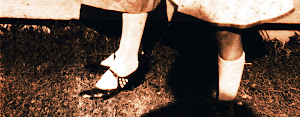
Was it a betrayal to forget the girl with the magical shoes and the old photographer--to diverge for so long from the path of their unfolding, tentative connection toward the dark path of the dead? When I returned from my grandfather’s hometown, still populated by the living who had somehow drifted far from my imagination, I was faced with the unassailable fact that the living are not as we imagine them--and the dead are far from caring how they are imagined. Driving back along the long road lined with sage and wide fields of cotton and corn, only the sky continued to maintain the vast scope of the extent of my romanticizing, but it was equally ominous and beautiful, like the road on which we traveled, unending, but also fraught with countless perils and disappointments.

Which is to say that only the girl with the magical shoes held any hope. She had a future. She was still holding the world together in a fragile web of apprehension (and I know I have used that over and over again, but find no other way to describe that act of apprehending--to catch, to reach, to hold, to arrive, to understand--as way of being, if only for a moment, but moment after moment, until the world comes together in an almost seamless act of being held).

Years ago I sold everything I owned, and many of these things I had gathered from my grandfather’s cellar after he died. Among those things was a book that had figured profoundly into my young imagination, a 1950 copy of Time-Life’s The Universe. One thing that worked its way into my consciousness was an artist’s depiction of Saturn as seen from one if its moons. In my young, preliterate mind, that landscape was somewhere on this planet, California, as a matter of fact, where one could see Saturn setting, an immense ripe fruit on the horizon. Many years after this purge, I found a copy of the same book in a used book store. I opened it and it released the sweet aroma of tobacco that had infused everything in my grandfather’s room. I picked it up the other day, and started, for the first time, to read it. There was a photo of Albert Einstein, and one of his office the day he died. The only title that one can make out on his desk is “Philosophy.” But reading again through the description of the theory of relativity, I suddenly understood that one can only really “see” the world by holding still. It can’t be seen through memory, or fear, or hope, or desire, or frustration. One cannot speed through it on an expressway or an airplane without missing the most essential details. This was always the girl’s gift. She longed for nothing, she raged against nothing, she simply stepped off the G-Train and looked around her, and the world, which never failed to perform its balletic miracle for anyone still enough, goal-less enough, to perceive it. And that is where she met Sudek--in that space of apprehension, on the point of the needle. And that is precisely why I lost them both for so long.

Thursday, August 9, 2007

Wednesday, August 1, 2007

the mother road


This book is dedicated to historic Route 66, the Mother Road. One day it will be gone. Pieces of it disappear as I write this line. And when it dies, among its remains will be many tales and memories of the way it never was, and that’s all right; for the road is mythic, and myths tend to swell with each telling. From now on, let every tall story begin: Once upon a time there was a great highway…

And that part is true…

--Carol O'Connell

Maybe there is no longer a need to exhume the ghosts of the past. The dust is so thick, and memory solidifies into untrustworthy forms. You might realize, rifling through a stack of parched papers, insistently engraved in your grandfather's hand, that there are many stories, but not enough love to sustain them. What use is it to dredge up what is lost, what was lost long before the breath moved out beyond the atmosphere. You might say that these stories, were, after all, always your own, your desperate attempt at redeeming what can never be redeemed. Then so be it. Let the dust settle as it was meant to do, to cover by patient accretion the no-longer-living.

There was a road that once was vital and well-travelled, and music and dancing and camping flitted along its expanse beneath the neon lights from Chicago to L.A. The road is gone, and though you might keep driving, you will never reach the destination.