Monday, January 7, 2008

civilization


In every important way we are such secrets from each other, and I do believe that there is a separate language in each of us, also a separate aesthetics and a separate jurisprudence. Every single one of us is a little civilization built on the ruins of any number of preceding civilizations, but with our own variant notions of what is beautiful and what is acceptable…We take fortuitous resemblances among us to be actual likenesses, because those around us have also fallen heir to the same customs, trade in the same coin, acknowledge, more or less, the same notions of decency and sanity. But all that really just allows us to coexist with the inviolable, untraversable, utterly vast spaces between us.
-- Marilynne Robinson, Gilead

And so the magic of winter slowly fades. The time away from work and school has allowed me to wander far from the steady stream of comings and goings of human life, the urgent and not-so-urgent errands and routines which drive the species to and fro in little inscribed paths on the surface of the city. I have slowed down to an almost imperceptible breath. I could be dead, for all I know, or a ghost. But the house is populated by two children and two animals who seem to respond to my presence. I must still be among the living.

Today on the creek we are alone, and the dry leaves are flicking like sharp, tiny tongues across the surface of the whitening rocks. There is a strong smell of dead fish. I find a stone and remember a friend who used to place a pebble in his mouth to stave off thirst on long hikes, but I can’t remember who it is anymore, who among the parade of ghosts who vigorously people my memories and dreams--and I am not putting this pebble in my mouth. It has absorbed the smell of dead fish, so I rub it between my fingers as we walk, like a worry bead.

We come across a smooth, deep rivulet, from whence arises the odor of dead fish. It is cut deep into the chalky surface, and as we peer down we see hundreds of small silver fish gasping for air among the carcasses of the already dead. I look up at the sky. It is cloudy, but rain seems unlikely. I consider the farfetched idea of buckets of water hauled down from up top.

As we walk back home I pray for rain. Several times during the day I do, weighing the likelihood of an answered prayer for dying fish against the grave, urgent prayers mouthed by the suffering the world over. But in this place that I am, this remote, unpeopled quiet of the winter holidays, I know that civilization is simply something that seems important, something that lives in the mind along with infinite desires and stories that are no less sensible that the small stone between my fingers.(1)

The clouds dissipate at dusk. My prayers fell on fallow soil, or I didn’t pray sincerely enough, or there is nothing such as an answered prayer. I let all the possible worlds of this play in my mind as the first stars appear, knowing that what is sanity, what to me, is civilization, is that smooth cleft in the earth where the tragedy plays out without tears or prayers. Tomorrow I will immerse myself once again in the river of humanity, and I wonder if I will even remember that fragile, passing world.


p.s. Hours after writing this, I awoke around midnight to a light but persistent rain...

Thursday, January 3, 2008

beginnings


the fragments that began “redemption shoes” were perhaps never to become more than a chaotic collection of thought objects--in any case, I doubt the collection will ever be reconciled into a meaningful whole, the way a story or a novel would, which in many ways was my intention--to experiment with a formless collection of ideas. But the idea of a codex devoid of a telos runs counter to my fundamental grain. I think I have always believed that if we looked far enough and deep enough, one day the mystery would be resolved. The mystery of what? Of self, of human nature? I cannot know, but remain resolved in my belief in a unified theory of everything, an Answer. I think this is why we tell stories at all: we craft the inklings of our vestigial knowledge into sensical or quasi-sensical forms, if only to communicate to ourselves what we already know. It was that spirit that fired the passion of Schliemann, whether one believes or not that his discoveries were nothing more than a hoax, the principal remains to intrigue us with its beauty and simplicity--that all we need to know, all we can ever know, is perpetually recorded in the cryptology of story. I will not quit searching, although the fragments of the grandfather have faded.

Monday, December 31, 2007

looking back


for tom

recorded in her notebook on January 2, 1990:

I do not know why
we can love so hard
and so awkwardly, why now, under the shadow of the locust trees,
the air has turned purple, and the streets--
which are simply returning from rain--
appear permanently stained,
why there is such a thing at all
as loneliness…

--Charlie Smith

New York City, Spring 1987
Let us begin again, twenty years later, because she had fallen in love with a sad lost soul, a historian (or was it literature, or art, or architecture?) dredging through the morphemes of a lost language looking for some memory of himself. He manufactured himself anew each morning, bolstered by the stiff morning light, propped up by syllables, mumbling their sounds like a mantra as he shuffled toward his stuffy office in the history department on Washington Square. She is walking down a quiet Brooklyn sidewalk. Unlike other sidewalks, it is paved with flagstones beneath which, over time, the earth has shifted, so that now, as the heel of her boot strikes the surface of the stone, a clear sound rings out. She is unaware that this sound changes the tissue of the air around her--that time cringes uneasily and recoils from its standard procession. She does not yet know that hope ripples outward upon the waves of this sound, permeating the air around her and the ancient bricks of the row-houses that line the sleeping street.

Before I built a wall I’d ask to know
What I was walling in or walling out…
Something there is that doesn’t love a wall
That wants it down


He had inscribed a quote from Rilke inside the cover of The Last Temptation of Christ: “For one human being to love another--that is perhaps the most difficult of all our tasks, the ultimate, the last test and proof, the work for which all other work is but preparation.” He was not a dream, but a man she had dreamed years before, who had poured into her open hand several lovely stones. Twenty years later she knows the names of the stones: Merton, and Teilhard de Chardin, and Rilke, among others. Kazantzakis was the stone that introduced her to the struggle in which every man partakes: My principal anguish and the source of all my joys and sorrows from youth onward has been the incessant, merciless battle between the spirit and the flesh. She was twenty; he was almost fifty, but he often irritated her by saying he could not wait to know her when she was forty.

In 1990 she will be given a lovely, blank book by her best friend, whom she has betrayed or soon will betray, at the expense of the most tender friendship she will ever know, and will begin writing poetry. It is awful. We must endure this poetry for six or seven months before she abandons poetry for cooking. A dreadful poem about her mother is followed by a recipe for tabouli, then vegetable stroganoff, and ratatouille.

Then, somewhere in my dreams
A fog-torn place and funneled silence


By 1991, a week before her birthday, he will be dead. Shot in the heart. A self-inflicted wound, and suicide becomes the language of love, the last mumbled syllable of a man who existed out of time. In the last months of his life, even she had dismissed his lack of consonance with the world of the living. She hardly noticed the glistening stones, and they kept tumbling into her hands, passed on often by regretful emissaries.

He died on March 4th
With spring snow on the ground
Alone in his pavilion. Seated at the foot of his bed.
Holding his shoe.
His body did not burst into unforgettable fragments at his death, no.


In 1996, the recipes will temporarily cease. She will quote Meister Eckhart and Herman Melville, and make pithy evaluations about the last six years, followed shortly thereafter by an unhappy marriage and two recipes: aduki bean squash stew and Italian Riboletta, the latter being of excellent literary quality.

(She misses him. He had this way of seeing her in her faults, and shaking his head with so much love, saying, "Aw, sweetheart." And she is forty now. She knows who the woman is that he wanted to know. She would have liked to know him, too, at seventy. There were so many stones. She never thanked him for the stones.)

If nature will not tell the tale
Jehovah told to her
Can human nature not survive
Without a listener?

(quotes above are from Robert Frost, Nikos Kazanzakis, Celia Thaxter, Anne Carson, Emily Dickinson)

Friday, December 28, 2007

cronos and gaia


Image credit: Carlos Parada, Cronos

I passed most of the morning in bed, watching the sun, which was transformed into a milky haze by the dust of the windowpane. On days when I don’t have to be anywhere, it is almost impossible to leave the house during the hours when the sun describes its balletic arc along the southeastern perimeter of the house. Sleeping is allowed, even reading, as long as you wake or raise your eyes from the page and occasionally behold the sun--mostly, you may not leave the presence of the sun. For about two hours (say from one until three o’clock p.m.) the sun will be intercepted by a windowless section of the house and a large Arizona Ash that visits from next door. During this time you can go out.

From the front door step of our house you have two options. Going East leads to hip cafes, divy clothing shops and a used bookstores, beer, and wine and coffee--all that civilization has to offer can be found by going east. To the west lie the hills, the creek, the Spings, and the trails. This is the direction I most often find myself leaning, and even walks with an intended eastward direction usually are delayed by a westward jog. Today we head purposefully west, down to the creekbed with a thermos of green tea, an apple and a small container of milk. The sun is filtered by the overhanging vines and riparian trees, and we walk a long while before lighting upon a sunny, rocky place in the center of the creek bed, dry for weeks now. It is as if the underwater world was suddenly frozen in time--the rocks, the plants, the algae are all a milky white. Above in the blue sky, buzzards watch us.

The highway arcs above like a great serpent. It’s hard not to resent its ignominious presence--even if you cannot see it, it effects a constant drone that eventually comes to resemble the wind in the cottonwoods and sycamores--and all the more despicable because of it. We find crawdad parts, some fox fur, and scattered feathers--signs that some sort of normal, natural parade of life and death continues unhindered. Yes, I realize that in saying this I betray some fundamental principal of ecology that says we are also nature, not separate from it--but lately, and as always, I doubt this and feel we are aliens consuming this world and shitting it out in our hideous wake.

Last night we read the story of Gaia and Uranus, and I am again reminded that myths hold the key to many mysteries. As we walked down the creek, searching for treasure, I wonder about the Titans and the hundred-headed monster and the cylopses Uranus tossed into the depths of the earth. What do they tell us about who we are, about where we are going, and which direction to head in the hours devoid of perfect, dancing light.

Sunday, December 16, 2007

the lost ritual


She would say that there had always been a voyeuristic element to her personality--and she had confessed on countless occasions to close friends that she often felt like a ghost haunting even her own skin--displaced, oddly unhinged and out of time, wandering through life as if she were looking at photographs musing on the present as if it were instead the past.

It is early and cold, and she is irritated because she forgot to buy coffee and so she must perform the ritual recollection of the particles of herself without the binding power of caffeine. It puts things right again, things that have shifted out of place during the night, pieces of herself moving just so slightly that the machinery cannot function, or worse, pieces that have drifted so far she must call them back patiently. She sometimes performs this ritual in bed, but today she does it with a cup of tea, watching the morning sun cleave the cold from the skinlike fronds of an agave across the street.

Today they will procure the Christmas tree. This is a quasi-ritual fashioned over the years for her three children intended to replace the Lost Rituals of her childhood, which they cannot know about but she is sure they suffer anyway for the loss. The quasi, replacement ritual feels unutterably lame to her, a vague and insincere gesture toward Holiday, but it is as close as she can come to the Lost Rituals.

The Lost Rituals exist in a space-time vault accessible to anyone who participated in them, and are additionally supported by photo-documentation lest any of the details grow blurred or risk being forgotten. Most of this documentation was performed by her grandfather, who was socially inept, and an in-law privy by marriage to the rituals so he was never a bona fide participant. He used the camera and a highball as a foil.

The Lost Rituals were led, and performed for numerous, happy years, by her great-grandparents. They were working class who had made it to the middle class, and they owned a large house comfortably furnished with overstuffed sofas and Victorian era relics all organized upon a vast sea of white carpet. The formal living and dining rooms were where the ritual was celebrated. There was always an enormous flocked tree. It was hand-flocked by a local nursery and delivered in a giant plastic bag. The ornaments were never eclectic--simply iridescent glass balls and fake birds, and multi-colored lights.

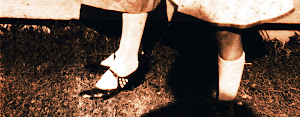
Those who participated in the rituals wore their finest clothes. One year, when she was five, she recalls a nondescript dress with red polka-dot stockings. She can still vividly recall those stockings, and the joy they filled her with as she looked down upon her dancing legs. Others wore fur, or silk--for all day the great -grandparents had been engaged in the preparations--baking brisket and pie, making jelly and jell-o salad, rolling out biscuits and mashing potatoes. Then there was the eating and revelry, the present opening, and singing, and the laughter that had been looked forward to by all for the entirety of the long year.

At the time of the red polka-dot stockings, her family lived on a farm in the country, about an hour from the town where the grandparents lived. Her mother had grown up with the ritual, and would never have conceived of missing it, or worse, replacing it with another family’s ritual. On Christmas Eve they piled into the Buick with all their finery and drove the deserted farm roads the hour or so to the grandparents' and reveled happily until Midnight, when the grandparents informed everyone that Santa Claus would pass the houses by if the children were not asleep in their beds, so the the parents would bundle up the little ones--it was most often snowing--into the night and ferry them homeward.

Her mother and father always seemed happy during the ritual, but on the way home they began to shake off a studied composure to be replaced with bridling resentment. He has had too much to drink, the mother bristles at the father. The children in the back seat are not listening to the fighting, nor are they noticing the slight weaving along the curving canyon roads in the snow. They are scouring the black, star-filled night sky for signs of Rudloph the red-nosed reindeer.

This memory has turned sour in her stomach as she sits by the window with her tea watching the sun dismiss the frost. She picks over the seeds of her life, and wants to reject them all, paling as they do in comparison to the perfect seed of the Lost Rituals. There came a time when the grandparents grew too frail to host the ritual. One by one the children attempted to recreate the magic, but none were able. Each in turn failed to produce anything that could have bound the disparate members together for even a single evening. There were many noble attempts. She looks back over her life and marks this loss as the end of uncontrived happiness.

And she thinks again of the snow, the long ride home on Christmas Eve and the three children huddled in the back seat, unaware of anything but the magic of Chrismas: What if?

What if he had, while the mother nagged in the seat next to him, and the stars bore down brightly upon him, and the thought of the falling price of cotton that year and the incessant desires for things he struggled to provide, and he did, after all, have quite a lot to drink-- and the sheet of ice was glassy and beautiful and reflected the night, and when the wheels hit it, the Buick went spinning off into the snow with great speed, tumbling over and over, almost with a whisper in the forlorn fields of snow, to rest, at last, in the silence of the frosted winter grass. Not a movement, not a breath.


There is a shear force of will that turns the cantankerous wheels of fate in unseen directions. There was so much will that night, maybe only the children in their joy was enough to muster a mighty cry against the Great Inhuman Will, and they rose up in their joy with a resounding NO! Time, like a mighty steam engine that slams on the breaks to avoid hitting a cow on the tracks, issued forth a terrible sound of immense friction. The world shuddered. The animals pricked their ears. And the mother nagged, and the father turned on the radio. O, Holy Night was playing, and he took her hand.


They made it home safely, a little addled, though they knew not why. As the parents carried the last warm, slumbering body to bed, they felt as if somehow their lives have been irrevocably altered. The children dreamed of ice and silence. And this would never change. That night will always be the last night. The Lost Ritual will always be the last true thing they ever knew. And they will walk through life, and live, almost as everyone lives, but there will be a feeling, a vague, uneasy feeling, of being a ghost, haunting even their own skins.
Thursday, December 13, 2007

lost pengwin


Maybe you do not rercall what it felt liketo traffic in essences. Children certainly do, and when you happen upon a completely uncontrived essence, courtesy of some child just being, well, childlike, it is like a breath of sweet, fresh air.

When do we lose this? Some people, I think, do not, but why? Sudoku and crosswords are not the way to hold on to that fragile connection with utter expression, unhinged from expectation.

Monday, December 10, 2007

winter reading list

I am agitated.

Let me begin with yesterday. I met a Nigerian/German who could have been my favorite philosopher except my favorite philosopher, everyman, is wholly Nigerian--it was only his character who was German (mother?) and Nigerian (father?), but I took this to be a sign, nonetheless, and launched into a discussion of literature about which my new acquaintance knew nothing. He spoke perfect German, however.

But I could NOT retrieve the title of Ondaatje's Coming through the Slaughter which was where I had packaged this association along with a recommendation from "not my real name," Allan Smithee who had also recommended I read this. A woman at the party who might be this Nigerian German's wife tells me that the brain is shrinking because of Google.

But let me tell you what I will read over the break, if my brain will hold up:

Condorcet, Progress of the Human Mind or what some may know as Tableau of the Progress of the Human Spirit

Hugo's Notre Dames de Paris, and Thoreau and Emerson in small doses. I am still struggling with Emerson, and what seems to me to be something that today would look like a mental illness.

Meanwhile, I will work on my operatic singing. Every time I hit a high note my five-year old hugs me. She says it is because she loves it when I do that, but I wonder if it might not be simply self defense. So far the dog has not howled. I try not to think about the fact that my best arias are written for a tenor...

Most of all, do not sit around this holiday and drink beer and eat cheetohs (as was recommended by one of my classmates). Life is too short, and although I subscribe to both beer and cheetohs, have them over Condorcet of Virgil, or Hugo. We'll all watch the Big Lebowski in heaven...