Tuesday, May 29, 2007

falling


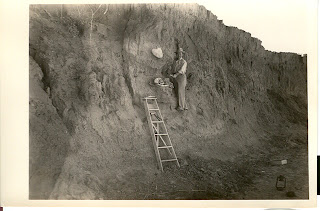
HCP, the palisades, 1949

Maybe children wake to a love affair every other morning or so; if given any chance, they seem to like the sight and smell and feel of things so much. Falling for the world could be a thing that happens to them all the time. I hope so, I hope it is purely commonplace. I’m trying to imagine that it is, that our childhood love of things is perfectly justifiable. Think of light and how far it falls, to us. To fall we say, naming a fundamental way of going into the world—falling.
-William Kittredge, Hole in the Sky

Maybe the exact lack of verticality makes us flatlanders more susceptible, but I fall, every day. Lately dreaming of falling, on days I forget to fall, days where I am fundamentally oriented toward the everyday world. But I am hardwired, I think, to fall.

I think Sudek was falling, all the time, falling in love with light, and perpetually seeking that moment when light fell magically between the cracks and illuminated the forgotten spaces of the ordinary, rendering them extraordinary, if only for a moment. Tonight that happened. A large palm-like fern with sturdy fronds bursting forth from its center (so much rain--the streets become rivers, we paddle between dreams) had attracted my attention. I got the camera, focused with the light fading in the west, just as a lizard darted from the fronds, startled by my interest.

By day I had forgotten him, but at night he haunted my dreams, he waited. I remember the girl, and her approach, at twenty-one, with no fear, declaring, I am dreaming you. But at forty-one you wait for what you long for, though it dreams other dreams halfway around the world, in some Nordic light, you wait.

Monday, May 28, 2007

archaeology iv: cryptography


My job was to walk and look. We were looking for remnants of whatever had once been alive in this desert, reduced to a polished trace of what it had been: an edge of an old mud wall, flakes of bones that had risen to the air after three or four thousand years and made a shining scatter on the surface of the sand like snow.
--Susan Brind Morrow, The Names of Things

I had mentioned the burdens. And so I arrived to claim mine from the most baffling of American traditions, the storage unit--a sea of anonymous cubes in which god-only-knows what mysterious items are secreted away into blind oblivion that we either have no room for, or are ashamed to keep in our homes, or are simply the by-products of the thing disease. It would be an interesting investigation to one day order them all to be opened, and the contents catalogued, and an entire exhibit opened for the world to see.

The contents of mine were as follows (* indicates these were childhood belongings):

one doll house*
one metal rickshaw*
one box of several old lamps
one wicker basket of stuffed animals*
a trunk-sized Rubbermade tub of ancient recordings (including Glenn Miller, Uncle Remus, and and Aunt Pat's RCA record-your-own entitled Christmas 1947 and various piano sonatas)
one leather and cherrywood coffee table with brass feet
one pie safe, green, without doors, painted over with white acrylic paint
several plastic bags of stuffed animals
one child-sized teepee
two end tables (one pillar shaped one where my grandmother hid her erotic novels)
Christmas decorations
one musty suitcase
one large chair with a high back and blue floral upholstery
a 1939 Royal typewriter

The typewriter was the first thing I saw. It bears the label “Kemper Military School--Booneville Missouri” and is blood red metal in a musty black case. The keys are still luminous, like small lacquered stones. It was, of course, my grandfather’s, and it evokes memories of his furious typing away the hours in his room on Lipscomb street. He had an obsession with writing implements, and I remember the first electric typewriter he bought for my sister, and the lengthy hours of explanation for its use. Every Christmas he would buy her a lovely set of Cross pen and pencil. He wanted writing to be hers, the way it was his.

What was he typing? My grandmother did not clean out his room for many years after he died, and so I slept there when visiting, so I could look through everything. His pipe collection, his reams of paper in the closet and drawers and stuffed under the bed. They were mainly legal briefs. He might have been tinged with a slight case of graphomania, I do not know, but he seemed to always be tapping away as if life depended on it.

As I sit here awake at 3AM, I somehow know the familiar comfort of just laying down word after word, the letters falling in like little pebbles from your hand in some possibly vain hope of forming something beyond a mere scattering of syllables. Or maybe for the sole reason of the tapping on the keys, the looking for some polished trace of what has been, or what might or never be.

Friday, May 25, 2007

where drought is the epic*


H.C. Pipkin, Little Red River, 1947
*from Adrienne Rich, The Desert as Garden of Paradise

By 1970 the town was nothing more than a small oasis in a sea of dust and corn. The old Victorian courthouse in the center of town with its clock tower and pitched roof had already burned to the ground twice after being struck by lightning. It had been replaced in the '50s with an industrial-looking concrete structure with bare slab walls whose sole decoration was a series of large black and white photographs of the Dustbowl--entire farms being consumed by a cloud of thick sand as high as a thunderhead. She would often stand for hours in the dimly-lit halls of the courthouse--it had no windows--staring in wonder at the images behind the glass. The new courthouse stood in the shadow of the tall grain elevators blocks away on the edge of town, and was flanked on all sides by the drugstore, the Post Office, and the T.G. and Y. The bank and grocery store were less than a block away. By fall of 1970, the population was just reaching two thousand.

The site for the town had been surveyed in 1848 by Clovis Handstock, a twenty-one year old Virginia native who, to his credit, sensed an unusual vibration when he stood alone on the prairie near Old Salt Creek. As he slept at night beneath an intricate web of stars, his dreams tended toward the mythological--he dreamed history in reverse, a future unraveled before his eyes like a sweater. He dreamed of the Dustbowl and a Kiowa war chief and a solitary girl dreaming of him, somewhere far off, in a house where she waited her whole life for a man with wings.

Soon afterwards the first settlers began to arrive, mostly immigrants of German descent with a strong reverence for God and nature, who did not anticipate the capricious nature of the wind, nor had they yet encountered the particularly deadly breed of tornado indigenous to the Panhandle. For generations to come they would battle dust and wind, and they would drink from wells dug deep down into the heart of the limestone channel where prehistoric water had coursed beneath the surface of the prairie for millenia. It would be many generations before they realized that the source they plundered to irrigate their crops and feed their livestock and wash their automobiles and flush their toilets, was an irreplaceable vein, rare and pure, and possessing of strange properties. By 1970, travelers driving north or south on the new highways which cut across the flat earth like surgical incisions, could not but admire the tenacious and resourceful farmers whose arcs of shimmering water spouted from monolithic, mobile sprinklers beneath the unforgiving midday sun.

(from The Penetrable Air)

water

“it is no place of seed, or of figs, or of vines, or of pomegranates”
-Numbers 20:5

you would come to understand that
though you stood at the river for a long time
you could not drink.
there was a language of such vessels
devised in vain hope to stave off thirst:
cistern, well, jar, broken cup
each syllable falling hollow on the throat
of a dying bird
others would simply adapt to lack--wretched species
wanting after every drop
but never hiding from the wind, or dreaming of rivers
but of cottonwood and white seed that covered the blanket of a sleeping child,
high in the mountains…

If there were water
And no rock
If there were rock
And also water
And water
A spring
A pool among the rock
If there were the sound of water only
Not the cicada
And dry grass singing
But sound of water over a rock
Where the hermit-thrush sings in the pine trees
Drip drop drip drop drop drop drop
But there is no water

(-T.S.Eliot “The Wasteland”)

…only
thirst.

Tuesday, May 22, 2007

beasts of burden


Thus the life of someone whose existence has somewhat preceded our own encloses in its particularity the very tension of History, its division. History is hysterical: it is constituted only if we consider it, only if we look at it--and in order to look at it, we must be excluded from it. As a living soul, I am the very contrary of History, I am what belies it, what destroys it for the sake of my own history (impossible for me to believe in “witnesses”; impossible, at least, to be one.
--Barthes, Camera Lucida


I choose this photograph for its burdens. My mother is the tallest child, flanked by her cousins. But what interests me here is not the human life, but the furniture. I grew up with the small marble table behind her, and I vividly recall the way the rough edge of the metal bites into your hands when you try to pick it up. I recognize every piece of furniture in that room, by a leg, or a surface--like distant relatives. These are the things we carry, our burdens of the past, what we are afraid to let go of. I know it’s not about the value of the furniture, but about some other ineffable quality. And it is a disease. My mother has two households of furniture in storage for she suffers from this disease, the collector, the archaeologist, the unwitting beast of burden of the past.

When I moved a few days ago, I sorely felt the weight of all these artifacts, yet could not let go. Why? Perhaps this is why we have museums, because we would rather let go of nothing, but eventually we must, so we select what will be remembered and maintained in climate and humidity-controlled environments, and we create hypermediated access to the past through its artifacts. A museum is a just big storage room of the past. Every new home I create feels like a museum to me, whose collection serves to remind me that I will never be free.

Lineage reveals an identity stronger, more interesting than legal status--more reassuring as well, for the thought of origins soothes us, whereas that of the future disturbs us, agonizes us…but this discovery disappoints us because even while it asserts a permanence…it bares the mysterious difference of beings issuing from one another and the same family…
(Camera Lucida)

Thursday, May 17, 2007

suspended


Perpetual Motion
New York Public Library Digital Collection

New York, 1987
It was November and cold when they left the city. The police had shot someone on Washington Avenue, point blank from the car window of the patrol car, and the body had lain in the street for hours covered by a coat. Whose coat? Someone had come with a coat and laid it over the victim, and she did not know who he was, or how old, or why. There was no ambulance, no siren, and children skipped rope and kicked balls across the street near the park where the body lay, mutely witnessing everything, mutely witnessing nothing. Or had she dreamed this? Staring out the back window of the car watching the city shrink, she no longer knew what was real and what was imagined. There was the baby, and her needs were distinct and direct and the rest of the world was like that granite skyline, disappearing below the horizon. She had no idea what existed beyond the perimeter of the life she had abandoned, of what her exodus promised or threatened. She was a particle suspended in time, displaced even from her self.

Prague, 1972
In the mornings there was coffee, thick and dark, and the rousing light, erasing the charcoal of the night, the rhythmic scratch of the needle on the turntable, the vibrato of the cello restoring the world to order. He lit a fire and settled into the morning, allowing the space of the room to shift around him like a comfortable coat. And then he watched, watched the hushed particles of light suspended in the cold morning air, rising in concert with the melody, disappearing in shadow, a balletic virtuosity of dust. Time eddied and collected and dissipated, and the coffee grew cold, and loneliness settled into the empty spaces vacated by the music when it faded and the needle once again lapped at the edges of the record, and this could not be repeated until the next morning. He had tried. The re-creation of the morning was a product of the hours, a whimsy of time. Throughout the rest of the day the loneliness would settle in his bones, and he would pass the hours arranging objects and printing negatives, until the cork could be popped to deliver him again to the long, abject oblivion preceding the blessed ritual of morning.

Tuesday, May 15, 2007

blood and water

the archaeologist

The last buffalo killed in Jack County was a tame buffalo of Dr. Cornelius, killed in 1875 by Alf and Mary Casey through mistake, out hunting in the Lost Valley. Of course they very much regretted the killing. (Ninety-four Years in Jack County)

Humans have resided in the canyon for approximately 12,000 years. Early settlers were nomadic tribes that hunted mammoth, giant bison, and other large game animals. Later, Apache Indians lived in the canyon, but were soon replaced by Comanche and Kiowa tribes who resided in the area until 1874. At that time, Col. Ranald Mackenzie was sent into the area to transport the Native Americans to Oklahoma. Col. Mackenzie and the 4th Cavalry were able to capture over 1,400 horses belonging to the tribe. After keeping some of the best horses for themselves, the remainder were taken to nearby Tule Canyon and destroyed. Cut off from their only means of transportation, the Native Americans soon surrendered.

One of the odd cominglings of blood and geography in my family--the paths we etch into the landscape with our desires, the trails of tears. I spent many childhood summers in the canyon, and its cool recesses lurk wolf-like along the perimeter of my imagination on hot summer nights. Before the roads were paved and the state park mitigated the wildness to the greatest extent to promote tourism, we wound down hairpin turns over seasonal creeks that had washed many away to their deaths during flash floods. We passed nights in an old German stone house, solid in the core, with a large hearth, louvered windows and French doors that opened onto a screened porch that completely enclosed the stone core, as wide, or wider, on each side than the diameter of the interior. This is where we slept, or tried to sleep, through the sweltering nights amid the deafening drone of crickets and the haunting whistle of trains and the mournful calls of owls. Perspiration gathered on our necks and behind our knees, and we dreamed fitful dreams of water snakes and wild indians.

My great grandfather, as amateur archaeologist, had haunted this landscape long before this, knapping flint and excavating artifacts for the Museum. But long before even that, the Kiowa and Comanche had roamed the fertile riparian paths. Satanta was among them, a great warrior for whom my grandmother's paternal great-grandparents had delivered his infant son at their mercantile outside Fredricksburgh. Later this child would mature into a young man, and her maternal great-grandfather in Jack County would sentence him to be hanged.

Theodore Specht, Fredericksburg pioneer, was born in the province of Braunschweig, Germany, on April 17, 1810. He became captain of a sailing ship in Germany, and on his last voyage his ship was destroyed and he was believed drowned. Although Specht was eventually rescued, the accident cost him his hearing and his fiancée, who, believing he was dead, married another man. Specht eventually married Maria Berger in Germany and immigrated with her to Fredericksburg, Texas, in 1846. Their first child, Christine, was born on March 14, 1846, but died of exposure in a spring storm when she was only a few days old despite being held by her mother in a feather bed. Specht and his wife had seven other children who lived to adulthood. In his home Specht opened a store that became popular with the local Indians, who traded honey, bear fat, and meat with the colonists. The Comanche chief Santa Anna* was a friend of Specht's; one winter night he rode up with one of his wives and asked for a room with a fireplace for her. She bore him a son that night, and when he returned the next morning he asked Mrs. Specht to follow him to the creek, where he broke the ice and dipped the baby in the water. He then patted a handful of water on Maria's breast, proclaimed her the mother-in-God of his son, and gave her an engraved silver disk in payment for the lodgings. Specht became the first postmaster of Fredericksburg on December 7, 1848; he operated the post office in his store and was the local agent for the Neu Braunfelser Zeitung beginning in 1852. Through the Department of Agriculture he brought into Gillespie County a variety of wheat and rye that benefited local farmers. He also collected local insects, lizards, and snakes, preserved them in alcohol and shipped them to naturalists in New York; he sent the money he received from them to his mother in Germany. Specht died on June 4, 1862, and was buried in Fredericksburg.


*This is excerpted from the Handbook of Texas online. Later research would show that this story is only partially true. The Indian chief was the Kiowa "Satanta," not Santa Anna, and Theodor Zeisig Specht entered the port at Galveston on the ship, The Louise, with eight children, the youngest being two at the time. Maria Bergert was a Catholic from Braunschweig, as verified through the meticulous German Catholic christening records. Theodor was actually from Poland, and very probably Jewish (as evidenced from various phrases and cultural habits my grandmother recalls)--he was not present at any of the christening ceremonies of his children. The shipwreck is completely unverifiable.

The record of the Texas penitentiary in regard to these two distinguished prisoners is as follows:
Name—Satanta, Kiowa Chief, Registered No. 2107, Age unknown.
Nativity—Indian Country. Time Convicted—July term, 1871.
Offense—Murder. Occupation—None. Term of Sentence—Life.
Education—None. Use tobacco—Yes. Height—Five feet nine and one half inches. Complexion—Copper. Color Eyes—Black. Color of Hair—Black. Married—Yes. Residence—Indian territory. Money—None. Received—Novembe 2, 1871. Expiration—Life.
(from Ida Lasiter Huckaby, Ninety-four Years in Jack County)

Monday, May 14, 2007

archaeology iii: fragments disembodied


New York, 1985
She dreamed about time. There were places she would see when walking down a deserted downtown street, where time lifted her skirt and revealed something beneath the layers of the years. She could not explain this, how time existed in many layers at once, that when she met someone she could not tell whether she was seeing him in the present, the past, or the future. Some people she could only understand as "mythological" and others as existential imperatives. Such was her relationship to those who must be saved. They existed as eternal responsibilities, as opportunities for redemption.

He made her eggs the next morning, and they ate them wrapped in blankets on the cold wood floors of his Ft. Green apartment. He played Dizzie Gillespie on the turntable, which was vintage and scratchy, but sounded real, grabbable.


This was the state of Dewey's soul when he encountered Lizzie that day by the pond. While he was struck by the almost shell-like quality of the pain she carried around her body like a glaze, he was likewise aware of his contrary instincts to both protect and devour her. There was a variable at work here which did not exist in his other observations -- it was called desire, and he did not know the symbol he would use to represent it in any equation.

...objects are alive, they are witnesses…if you possessed the gift of touch then you might know that every single moment of time is preserved forever in the molecules of a room, or a chair, or a stone. If you possessed the gift of touch, then maybe you would become obsessed with cataloguing the stories that stretch out like long highways toward unknown places, and if you followed them, how would you ever find your way back home?
-from the journals of Grace Lightman


The human conscience balances on a fulcrum, leaning uncertainly into the past and the present, and that point, that finite but incomprehensibly elusive point of the present (which is its only true contact with anything solid) falls away beneath the mind and disappears from awareness. And yet, the physical laws governing a fulcrum exist within the context of the human consciousness, and should the mind become unhinged from this context, then the world comes unhinged from its laws.

When she returned from her wanderings, she seemed to possess a type of calm power. The hotel raised itself from the ground, its straight boards and smooth stones leveraged into place by some alchemy of her pain.

Are any events completely unrelated? How do things come together, at what points do they hinge, maybe even in the only moment they ever connect? How does CW Post relate to a girl walking alone along the Brooklyn streets at dawn, or a reclusive philosopher, obsessed with Kafka?

Math (chaos, physics, even economics—the connection between John Maynard Keynes and Einstein's relativity theory). AW Moore's article in the London Review of Books, "Millenium Problems" (July 22, 2004).

October 21, 1933
October 26, 1854
October 11, 1878