Sunday, December 16, 2007

the lost ritual


She would say that there had always been a voyeuristic element to her personality--and she had confessed on countless occasions to close friends that she often felt like a ghost haunting even her own skin--displaced, oddly unhinged and out of time, wandering through life as if she were looking at photographs musing on the present as if it were instead the past.

It is early and cold, and she is irritated because she forgot to buy coffee and so she must perform the ritual recollection of the particles of herself without the binding power of caffeine. It puts things right again, things that have shifted out of place during the night, pieces of herself moving just so slightly that the machinery cannot function, or worse, pieces that have drifted so far she must call them back patiently. She sometimes performs this ritual in bed, but today she does it with a cup of tea, watching the morning sun cleave the cold from the skinlike fronds of an agave across the street.

Today they will procure the Christmas tree. This is a quasi-ritual fashioned over the years for her three children intended to replace the Lost Rituals of her childhood, which they cannot know about but she is sure they suffer anyway for the loss. The quasi, replacement ritual feels unutterably lame to her, a vague and insincere gesture toward Holiday, but it is as close as she can come to the Lost Rituals.

The Lost Rituals exist in a space-time vault accessible to anyone who participated in them, and are additionally supported by photo-documentation lest any of the details grow blurred or risk being forgotten. Most of this documentation was performed by her grandfather, who was socially inept, and an in-law privy by marriage to the rituals so he was never a bona fide participant. He used the camera and a highball as a foil.

The Lost Rituals were led, and performed for numerous, happy years, by her great-grandparents. They were working class who had made it to the middle class, and they owned a large house comfortably furnished with overstuffed sofas and Victorian era relics all organized upon a vast sea of white carpet. The formal living and dining rooms were where the ritual was celebrated. There was always an enormous flocked tree. It was hand-flocked by a local nursery and delivered in a giant plastic bag. The ornaments were never eclectic--simply iridescent glass balls and fake birds, and multi-colored lights.

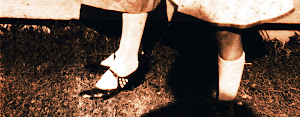
Those who participated in the rituals wore their finest clothes. One year, when she was five, she recalls a nondescript dress with red polka-dot stockings. She can still vividly recall those stockings, and the joy they filled her with as she looked down upon her dancing legs. Others wore fur, or silk--for all day the great -grandparents had been engaged in the preparations--baking brisket and pie, making jelly and jell-o salad, rolling out biscuits and mashing potatoes. Then there was the eating and revelry, the present opening, and singing, and the laughter that had been looked forward to by all for the entirety of the long year.

At the time of the red polka-dot stockings, her family lived on a farm in the country, about an hour from the town where the grandparents lived. Her mother had grown up with the ritual, and would never have conceived of missing it, or worse, replacing it with another family’s ritual. On Christmas Eve they piled into the Buick with all their finery and drove the deserted farm roads the hour or so to the grandparents' and reveled happily until Midnight, when the grandparents informed everyone that Santa Claus would pass the houses by if the children were not asleep in their beds, so the the parents would bundle up the little ones--it was most often snowing--into the night and ferry them homeward.

Her mother and father always seemed happy during the ritual, but on the way home they began to shake off a studied composure to be replaced with bridling resentment. He has had too much to drink, the mother bristles at the father. The children in the back seat are not listening to the fighting, nor are they noticing the slight weaving along the curving canyon roads in the snow. They are scouring the black, star-filled night sky for signs of Rudloph the red-nosed reindeer.

This memory has turned sour in her stomach as she sits by the window with her tea watching the sun dismiss the frost. She picks over the seeds of her life, and wants to reject them all, paling as they do in comparison to the perfect seed of the Lost Rituals. There came a time when the grandparents grew too frail to host the ritual. One by one the children attempted to recreate the magic, but none were able. Each in turn failed to produce anything that could have bound the disparate members together for even a single evening. There were many noble attempts. She looks back over her life and marks this loss as the end of uncontrived happiness.

And she thinks again of the snow, the long ride home on Christmas Eve and the three children huddled in the back seat, unaware of anything but the magic of Chrismas: What if?

What if he had, while the mother nagged in the seat next to him, and the stars bore down brightly upon him, and the thought of the falling price of cotton that year and the incessant desires for things he struggled to provide, and he did, after all, have quite a lot to drink-- and the sheet of ice was glassy and beautiful and reflected the night, and when the wheels hit it, the Buick went spinning off into the snow with great speed, tumbling over and over, almost with a whisper in the forlorn fields of snow, to rest, at last, in the silence of the frosted winter grass. Not a movement, not a breath.


There is a shear force of will that turns the cantankerous wheels of fate in unseen directions. There was so much will that night, maybe only the children in their joy was enough to muster a mighty cry against the Great Inhuman Will, and they rose up in their joy with a resounding NO! Time, like a mighty steam engine that slams on the breaks to avoid hitting a cow on the tracks, issued forth a terrible sound of immense friction. The world shuddered. The animals pricked their ears. And the mother nagged, and the father turned on the radio. O, Holy Night was playing, and he took her hand.


They made it home safely, a little addled, though they knew not why. As the parents carried the last warm, slumbering body to bed, they felt as if somehow their lives have been irrevocably altered. The children dreamed of ice and silence. And this would never change. That night will always be the last night. The Lost Ritual will always be the last true thing they ever knew. And they will walk through life, and live, almost as everyone lives, but there will be a feeling, a vague, uneasy feeling, of being a ghost, haunting even their own skins.

Thursday, December 13, 2007

lost pengwin


Maybe you do not rercall what it felt liketo traffic in essences. Children certainly do, and when you happen upon a completely uncontrived essence, courtesy of some child just being, well, childlike, it is like a breath of sweet, fresh air.

When do we lose this? Some people, I think, do not, but why? Sudoku and crosswords are not the way to hold on to that fragile connection with utter expression, unhinged from expectation.

Monday, December 10, 2007

winter reading list

I am agitated.

Let me begin with yesterday. I met a Nigerian/German who could have been my favorite philosopher except my favorite philosopher, everyman, is wholly Nigerian--it was only his character who was German (mother?) and Nigerian (father?), but I took this to be a sign, nonetheless, and launched into a discussion of literature about which my new acquaintance knew nothing. He spoke perfect German, however.

But I could NOT retrieve the title of Ondaatje's Coming through the Slaughter which was where I had packaged this association along with a recommendation from "not my real name," Allan Smithee who had also recommended I read this. A woman at the party who might be this Nigerian German's wife tells me that the brain is shrinking because of Google.

But let me tell you what I will read over the break, if my brain will hold up:

Condorcet, Progress of the Human Mind or what some may know as Tableau of the Progress of the Human Spirit

Hugo's Notre Dames de Paris, and Thoreau and Emerson in small doses. I am still struggling with Emerson, and what seems to me to be something that today would look like a mental illness.

Meanwhile, I will work on my operatic singing. Every time I hit a high note my five-year old hugs me. She says it is because she loves it when I do that, but I wonder if it might not be simply self defense. So far the dog has not howled. I try not to think about the fact that my best arias are written for a tenor...

Most of all, do not sit around this holiday and drink beer and eat cheetohs (as was recommended by one of my classmates). Life is too short, and although I subscribe to both beer and cheetohs, have them over Condorcet of Virgil, or Hugo. We'll all watch the Big Lebowski in heaven...

Sunday, December 9, 2007

notes to myself

This is a link to an indescribably beautiful short film by one of my favorite philosophers. I am as yet inept regarding how best to post videos--but however you get there, it is worth the trip...

I awoke around 1 a.m., thinking about Bedichek, and Dobie, and
McMurtry and this long lineage of Texas writers, and I should include
Dorothy Scarborough, of The Wind and Katherine Ann Porter, who are the only truly noteworthy females of
Texas literature, but I always longed, don't know why, to belong to the
"boys club."

This might have something to do with my upbringing, and the
pre-kindergarten days I spent with my dad travelling from town to
unnamed town in the panhandle, stopping off at grain elevators to shoot the breeze with other farmers analyzing the market and bad-mouthing the republicans (those were the days--now the farmers in that area subscribe to a different set of politics driven by a man who wouldn't know which end of a cow to milk, but he employs a familiar vocabulary and perhaps that is where we all draw the line).

Bedichek will be much on my mind over the holidays as I embark upon a rereading of his Adventures with a Texas Naturalist

the not lost notes...

I guess I need to figure out the plot of this story. Grace is born, is raised by her father, rather uneventfully in this small Texas town, which at this point hardly figures at all into the story—should it be a larger part of the story? More characters? Anyway, she is haunted by her mother’s suicide, an incident which her father only ever describes to her in mythological terms. When she is forced to confront her abandonment after her father’s death, she decides to open the lid of the past and find out who her mother was and what was the terrible secret that she carried inside her—what eventually drove her to suicide.

She moves in to the old hotel, her mother’s childhood home, and the past comes alive. Layer after layer of history unfolds as she discovers the many secrets held in the walls of the old building. She is about to lose touch with everything, to be consumed by the past entirely, when she meets Holcomb Howell, a young cropduster. What ensues is Grace’s first love, a passionate encounter with the living such as she has never known, by her mother’s secret has now become her own, and the desperate battle is now being waged within her.

Why am I doing this? I know that right now I couldn't care less about what happens in this stupid story. So let me tell you this. How when Grace returned home she sat for a long time in the living room of the German farmhouse, feeling the emptiness of the rooms. There was a stillness in the air that oppressed her. What she felt most keenly however was the feeling that though she had lived in this house her entire life, she had never felt that she quite belonged. There was a distance between her and every object that occupied the house, as if some unseen presence had hovered over her warning, “Don’t meddle, don’t touch,” until her curiosity had finally subsided.

This house was a body vacant of spirit, and she herself felt this vacancy of spirit well. She rose from the crackling, decrepit sofa and smoothed her skirt as if she was off to the kitchen to make tea or wash vegetables. She went to her closet and took out an old suitcase of a floral print in needlepoint. She packed the few dresses and undergarments she owned. Then she searched the kitchen drawer...for a key. They had never as far as she knew, locked any of the doors. But the kitchen door through which the entered and exited exclusively did have a latch and keyhole. At some length of rifling through the drawers filled with pipe cleaners and small parts of dismantled mechanisms of various kinds, she discovered a small and heavy key on a frayed and faded green ribbon.

Thursday, November 22, 2007

folded hands


I've been drawing on the train. Thirteen days ago, it
was an old Hasidim who hung his head low as he read
the paper. And, when he was done, he folded and
refolded his hands, constantly switching which was on
top, so that it seemed as if they were transparent and
you could see one old wrinkly hand right through the
other.
--y.o.

Last night a cold front blew in and I woke to frost on the glass. The house is quiet; the kids are away at grandparent's and it is just me in bed with coffee and the wind.

I love the idea of families all snuggled together today, sharing a meal, laughing and arguing and just, well--sharing one another's company and giving thanks for the beauty of their lives--just their lives, that is so much to be thankful for.

Being alone, I will do the sanest thing I know: First I will go for a walk on the trail. And I will pray for everything I can imagine. The things I am thankful for, the things I may take for granted, and for those who are not safely ensconced in the presence of loved ones, dysfunctional or otherwise.

Last night I heard on NPR that the police took a baby away from a Guatemalan mother who was breastfeeding her infant. They deported her, the baby (an American citizen) they kept here. I will pray that this insanity ends soon. There is so much insanity these days. Another insane commercial holiday looms---what are we thinking? Is anyone thinking? Sometimes it is almost unbearable to live in a culture whose concern is primarily "getting" and "having" more and more stuff.

I can't get the image of the man on the train, folding and refolding his hands, out of my mind. It is almost like the weaving of the fates--the perpetual folding, the neverending wringing of the hands--I imagine this is exactly what God does (metaphorically) as he/she/whatever, unnameable, watches the chaos below.


"

Wednesday, November 14, 2007

pseudo-random numbers


for allan smithee (not his real name)

Yesterday the 338 was rerouted at Lamar and 29th because of a 'hostage situation.' (One man, fending off the authorities in a gunshop--can one hold oneself hostage?)

The wind started blowing today; we headed out to walk the dog because the leaves were doing their best impression of the Shelley poem, like ghosts from an enchanter fleeing, yellow and black and pale, and hectic red--a pestilence stricken multitude... possibly very poorly paraphrased, and I always confuse that poem with Shakespeare's sonnet about "bare ruined choirs where late the sweet birds sang"...pestilence stricken multitudes. See?

She asks me: Who will take care of me when you are an angel?

I respond that I am very far away from being an angel.

But tonight the wind blows and the clouds move like the dead, soooo slowly. I imagine infinite layers into space, each moving exponentially slower than the one below, and suddenly I have lived an entire life, and I wonder, have I done what I came here to do?

perhaps I have forgotten what that was...

UPS delivers about 13 million packages and documents a day. If 1/100 of a percent (.0001) are lost, thats 1300 packages a day.

And then a perennial favorite:

Jilted by Sweden, Feted by Norway, Mathematics Finally Gets Its Due

Sunday, October 28, 2007

and belatedly, for beth...


Correspondence with A.E.Seale. chief of the Texas Prison System at Huntsville, Texas, in regard to the prison records of Big Tree and Satanta reveals that the two chiefs were received at the institution on November 12, 1871, each with a life sentence for murder, although some authors have stated that they entered the penitentiary November 12, 1871. Big Tree and Satanta were paroled August 19, 1873, but Satanta was returned as a violator November, 1874. (1)

W.A. (Bud) Morris and Joe Bryant of Mantague County conversed with Satanta while at the penitentiary (October 1878). Satanta had a talk with Mr. Morris and inquired if he thought the government would ever release him. Mr. Morris did not give any encouragement. Satanta seemed very despondent, and next morning, perhaps feeling his case hopeless, he committed suicide by jumping from a window or front story porch (reports conflict), October 11, 1878.

“I cannot wither and die like a dog in chains.”
-Satanta

The next day, Satanta slashed several arteries. An attendant stopped the bleeding and took him to the infirmary where he was lodged on the second floor. When the attendant left him alone, Satanta jumped from the landing. The prison record states that he died “from the effect of a fall received by voluntary jumping from a second story landing of the prison hospital.” (2)

1. Ida Lasater Huckaby. Ninety-Four Years in Jack County, 1854-1948. Texian Press: 1984. Waco,TX. P. 202.

2. Thomas F. Horton. History of Jack County: Being the Accounts of Pioneer Times Excerpted from Coutny Court Records, Indian Stories, Biographical Sketches and Interesting Events. Gazette Print,:Jacksboro, Texas. P.


Two

“Maybe children wake to a love affair every other morning or so; if given any chance, they seem to like the sight and smell and feel of things so much. Falling for the world could be a thing that happens to them all the time. I hope so, I hope it is purely commonplace. I’m trying to imagine that it is, that our childhood love of things is perfectly justifiable. Think of light and how far it falls, to us. To fall we say, naming a fundamental way of going into the world—falling.”
-William Kittredge, Hole in the Sky

There is a farm, a lake whose shores still bear the imprint of your feet. There are bones of coyotes in piles along the fenceline that remember your name, and a lineage of grain that held your body when you jumped into silos, held there in the vision of sun through the opening above, shadowed hands reaching down to grasp yours and pull you up into the light again. In winter the pond froze over, and you were friends with the stinging wind, whose fingers like needles, worked their way through the red nylon weave of your jacket, the flimsy barrier between the cold and the small-bird of a heart knocking against the cage of little ribs. There was a dingey sky blanketing the yellow fields, a carbonate road winding off into the gray like a vein of crystal. It was cold, so cold the air pinched the skin between your nostrils, you who were poised in animal attention, listening. You discerned that the norther had a voice all its own, separate from the southerlies or easterlies. The North wind moans, you thought, it was a lonely sound like a ghost train culling the darkness with a single shaft of light flaying the dark skin of night, or a lonesome calf bawling for its mother. And as you thought these words you sang, Glory be to God on high…

The sleek dark bodies of Canadian geese gather on the frozen lake into a mass against the gale, clump together, for a moment blot out their own separateness, then divide in startled unison, the broad wingspans pushing steamy gusts toward your huddled shoulders. They rise clumsily off the ice, honking and flapping in awkward, jerking skyward movements, then drop gently onto the creaking, opaque sheet again, as if an unseen cartoon hand had suddenly let them go. They settle down into the inky hole of water not yet overtaken by ice. You scour the muddy shore for more rocks to throw, averting your eyes from the crucified coyotes hanging with slit throats on the barbed-wire fence at the edge of the cotton field. And on Earth peace and goodwill toward men…

Your hands were red and chapped, even shoved into the pockets of your corduroy pants they were numb, so you walked back along caliche road to the metal pole barn rising in a sharp angle to the plain, wind-formed in a perpetual leeward lean. There was a wooden enclosure, it is there still, and in one corner of the barn, you found a pushbroom set aside and forgotten against the splintered siding. You pushed it slowly as if in prayer, making patterns in the fine orange silt with the stiff bristles of the broom. We praise you…The pool of unthinking induced by the slow scratching of the bristles on the concrete floor was rippled by the clunking sound of broom head colliding with bucket. The suspect contents sloshed out onto the dirty floor, collecting into puddles of sepia mud. You peered into the bucket then turned suddenly away. Fleshy blobs floated in the blood black water. Your brain struggled to give these shapeless masses a context. They were animal, severed, unspeakable, what? You heard a snicker from the metal stairs that lead above the office where the hay was stored. It was Romero, the hired hand.

Romero makes a gesture near his groin with his hand still holding a cigarette," laughing. You looked back at the bucket, your face paling greenish and shoved your nose beneath the cold zipper of your windbreaker so you would not vomit onto the floor you had just swept.

Over the throbbing sound in your ears you heard the chatter of sparrows roosting high in the rafters of the metal barn, hollow echoes in the cold air. There was a propane heater inside Buddy’s office, but here next to the combines and the bags of sorghum, it was bone cold. Even the cats had disappeared, crawled into spaces between bales of hay. The grain dryer started up then with a whine, like a siren, ran for a deafening eternity during which you sang sotto voce the remainder of the fragment of the Creed, We thank you, we worship you and sacrifice you, as it was in the beginning, is now and ever shall be Ah-men, then the dryer wound down, leaving the reverberations of its giant turning cylinders carving a headachey space between your ears.

The sparrows flitted down to pick over sprigs of straw, or candy wrappers or string, struggled in the fragile balance of gravity to return with the plunder to their nests near the ceiling. Sometimes it seemed the barn was a living creature, breathing with enormous lungs, and you, you were a creature inside clinging to its innards for warmth because you knew of no other shelter.

Romero finished his cigarette and walked down the metal stairs, his scuffed-up blood-stained boots slowly passed before your lowered head. You concentrated on the dust patterns on the floor. They were roads that you followed, circling spiraling roads leading up into the sky like the unseen roads the geese were supposed to follow south.

There was a road you remembered, from when you were still small enough to be slung up on your mama’s narrow hipbone. A cold day like this one, only sunny, your eyes squinched against the light that exposed the bareness of the land, the smooth arched whaleback of the earth spotted with cylindrical grain elevators. Your mother was thin, laughing, wearing a mint green dress that just touched the top of her kneecap, slender ankles cocked above high arches slipped into bone-white pumps, dressed more for an afternoon tea than to be tromping about in the dirt and tumbleweeds. Buddy drove with his wrist resting on the top of the steering wheel, raising two fingers in salute to passing pickups every once in a while, and occasionally swerving onto the shoulder of the road then jerking the pick-up back, so he could make your mama wince or gasp, and then she would laugh. He was taking you someplace special, to show you what he’d found on his hunting trip.

Buddy turned in on the loose gravel in front of a shoebox of a building. There was a lame horse hobbling around on the hardpan, and two longhorn steers huddled butt-end to the North wind that never seemed stop blowing the acrid sorghum smell into town, either that or the stench from the feed lot. You were lifted out of the pick-up and set down on the hard ground. And she held your dimpled hand as you stepped over Dr. Pepper bottles and shot-up beer cans, making your way to the chain link fence that enclosed a single dog run.

Do you want to look? your mama asked, you serious, digging the toe of your black paten Mary Janes into the orange soil. Your tiny hands gripped the cold steel and you poked your nose through the infinite linkages and infinite spaces between linkages, tasting the cold metal with your tongue.

Buddy strode around the back of the little dog house at the rear of the pen to bang on the wall of it, try to scare what was within, out. And he flushed out a mama raccoon wild-eyed, holding one of the babies by its scruff. Your mouth was poised in a perfect gasp of surprise, your Mama smiled, singing in a high-pitched voice Oh, How precious, and that was when it happened. First she swallowed the one she had by the scruff, just choked it down. Your Mama reached her gloved hand down to shield your eyes but she jerked your soft curled head away, for you had already seen the undeniable truth of it.

She ate all five of them, a visceral image that would become imprinted in the fore of your mind, an image you understood without having it explained and didn’t want it explained and would carry in your belly as a knowing about love that you would witness re-enacted countless times in your life and would never misunderstand the possibility, the inevitability of it. A cruelty wound tight with love, and inseparable from it.

It was this experience that must have awakened your mind to the many cruelties of farm life, or rather, farm death. The singular moment when something inside your small body became blind and ceased to see with an innocent child’s eyes.
But now you were older, an older sister, and you wondered sometimes how you would explain this brutal mother love to Billy when he was not a baby anymore. Billy, just born into the family line like a vein, the heart pumping into it not blood, but the life-sustaining liquid of worldly possessions.

Romero stopped, picked up the bucket and stepped off the concrete slab into dust, absorbed by the enveloping light of cloud cover. You could hear Buddy’s voice booming on the phone in the office inside that was filled with heavy wooden furniture that belonged to his father. Furniture that would one day be Billy’s. Buddy came out slamming the plywood office door behind him. Get in the truck, he told you, and you followed him out into the absence of sun, trotted around to the passenger side of the pick-up and scrambled in. You spoke beneath your breath the quick mumbled prayers you always said for the cottontails and coyotes and stray cats who might have been unfortunate enough to be loping along the highway just as Buddy’s pick-up truck came whining along the road. How you hated to see anything get hit. And by rote your lips mouthed the words of the contract, the terms being that you must repeat the entire Lord’s prayer before the truck reached the end of the caliche road where Buddy would turn off in a spewing of gravel toward town, For Thine is the Kingdom, and the power and the glory, forever and ever, Amen.