Wednesday, August 15, 2007

apprehension


I-84 between Lubbock and Post
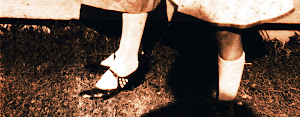
Was it a betrayal to forget the girl with the magical shoes and the old photographer--to diverge for so long from the path of their unfolding, tentative connection toward the dark path of the dead? When I returned from my grandfather’s hometown, still populated by the living who had somehow drifted far from my imagination, I was faced with the unassailable fact that the living are not as we imagine them--and the dead are far from caring how they are imagined. Driving back along the long road lined with sage and wide fields of cotton and corn, only the sky continued to maintain the vast scope of the extent of my romanticizing, but it was equally ominous and beautiful, like the road on which we traveled, unending, but also fraught with countless perils and disappointments.

Which is to say that only the girl with the magical shoes held any hope. She had a future. She was still holding the world together in a fragile web of apprehension (and I know I have used that over and over again, but find no other way to describe that act of apprehending--to catch, to reach, to hold, to arrive, to understand--as way of being, if only for a moment, but moment after moment, until the world comes together in an almost seamless act of being held).

Years ago I sold everything I owned, and many of these things I had gathered from my grandfather’s cellar after he died. Among those things was a book that had figured profoundly into my young imagination, a 1950 copy of Time-Life’s The Universe. One thing that worked its way into my consciousness was an artist’s depiction of Saturn as seen from one if its moons. In my young, preliterate mind, that landscape was somewhere on this planet, California, as a matter of fact, where one could see Saturn setting, an immense ripe fruit on the horizon. Many years after this purge, I found a copy of the same book in a used book store. I opened it and it released the sweet aroma of tobacco that had infused everything in my grandfather’s room. I picked it up the other day, and started, for the first time, to read it. There was a photo of Albert Einstein, and one of his office the day he died. The only title that one can make out on his desk is “Philosophy.” But reading again through the description of the theory of relativity, I suddenly understood that one can only really “see” the world by holding still. It can’t be seen through memory, or fear, or hope, or desire, or frustration. One cannot speed through it on an expressway or an airplane without missing the most essential details. This was always the girl’s gift. She longed for nothing, she raged against nothing, she simply stepped off the G-Train and looked around her, and the world, which never failed to perform its balletic miracle for anyone still enough, goal-less enough, to perceive it. And that is where she met Sudek--in that space of apprehension, on the point of the needle. And that is precisely why I lost them both for so long.

Thursday, August 9, 2007

Wednesday, August 1, 2007

the mother road


This book is dedicated to historic Route 66, the Mother Road. One day it will be gone. Pieces of it disappear as I write this line. And when it dies, among its remains will be many tales and memories of the way it never was, and that’s all right; for the road is mythic, and myths tend to swell with each telling. From now on, let every tall story begin: Once upon a time there was a great highway…

And that part is true…

--Carol O'Connell

Maybe there is no longer a need to exhume the ghosts of the past. The dust is so thick, and memory solidifies into untrustworthy forms. You might realize, rifling through a stack of parched papers, insistently engraved in your grandfather's hand, that there are many stories, but not enough love to sustain them. What use is it to dredge up what is lost, what was lost long before the breath moved out beyond the atmosphere. You might say that these stories, were, after all, always your own, your desperate attempt at redeeming what can never be redeemed. Then so be it. Let the dust settle as it was meant to do, to cover by patient accretion the no-longer-living.

There was a road that once was vital and well-travelled, and music and dancing and camping flitted along its expanse beneath the neon lights from Chicago to L.A. The road is gone, and though you might keep driving, you will never reach the destination.

Tuesday, July 24, 2007

the molecular composition of air


from Wisconsin Death Trip, by Michael Lesy 1973

Monday, July 9, 2007

june and boo, 1948


In one of his letters, Bedichek mentions a book by Alfred Russell Wallace entitled The Wonderful Century. In the chapter on photography called “New Applications of Light” he writes,” The improvements of the mode of production of light for common use …are sufficiently new and remarkable to distinguish this century from all the ages that preceded it, but they sink into insignificance when compared with the discoveries that have been made regarding the nature of light itself.” So much is changing at the turn of the century, and time itself is being compacted like the soil beneath any of dozens of heavy pieces of machinery moving the earth about to follow the contours of man’s desires.* Already, in 1951, Bedichek bemoans the passing of an era, the loss of the honey bee and man’s sense of wonder with the natural world. I am just a descendent in the lineage of the grieving.

Tricky thing, time--if you begin to move backward in it, like swimming against the current of some roiling river, it gapes and opens into an ocean, and what once was just a barely audible, far-off call of a vaguely recognizable bird is suddenly a roar so loud you cannot bear to hear it without clapping your hands over your ears. Do you, then, get back into your tent as God advised the Israelites?

Perhaps as we learn more, imagine more intensely, about the nature of light we will realize that nothing is lost, that it is all here in our midst, perceptible to some finely tuned instrument. Then I will quit grieving the maps and archaeological record discarded by an unappreciative librarian, or the Leica enlarger cast off as a bit of junk crowding the basement. Perhaps not. For now, I let my sighs join in a puddle with those of a fellow investigator of the past (although I know his sighs are spent with equal measure on the present, on the subtlest sound, the faintest shuddering breath).

Have we passed through the wonderful century? Are there any more poets being born?

*As Norma Evenson wrote in her 1979, Paris: A Century of Change, "And so, one hundred years is not so long. A century no longer implies a period of slow accretion." (xvi)

waiting for the bus


People Waiting for the Bus. Robert N. Dennis collection of stereoscopic views of St. Louis, Missouri. (created 1865?-1890?)Humanities and Social Sciences Library. Photography Collection, Miriam and Ira D. Wallach Division of Art, Prints and Photographs

Between the times I wander other people’s dreams of themselves at singular points of their lives they have forgotten were solidified in emulsion or inscribed onto a page, I ride the bus. The bus traverses vast expanses of the imagination, each intersection an unfolding drama that pulls me in, each new passenger a narrative unraveling. Yesterday we sat at a round metal table in the parking lot on Congress Ave where they serve coffee and I remembered the man in the Hawaiian shirt who often takes the same bus. He stands on corners with a sign that says, “Anything helps” or “Homeless Vietnam Vet.” Once I had taken the bus downtown at dark in a foul mood, and he had called out across the coach, You are the most beautiful woman I have ever seen, and then he pulled a crumpled zinnia out of his backpack and handed it to me. He rides with me again, he doesn’t remember, tells me I’m beautiful or asks me to marry him. He never remembers.

I toy with the idea of myself stepping onto the 338 crosstown bus and transforming into something ravishing, a bus princess, who emerges forty-five minutes later at the intersection of 45th and Duval, the intersection of this dream and real life, the same unremarkable self I was before 8:22 a.m. when the bus hissed to a stop in front of me at Manchaca and Lamar.

Why I am thinking about the bus in the parking lot on Congress Ave, I don’t know, because the parking lot is filled with people in sunglasses and dogs and the coffee is hot and my daughter is rocking forward and back in her metal chair and asking to go see the garden at the chic motel next door. Maybe it is just this sense that each one of these provocative moments, the bus, the parking lot, the girl rocking back and forth in her chair, are pressing from the inside of me, struggling to burst free to relieve the ache of this sense of passing, of missing, of losing these moments, all these moments.

Sunday, July 1, 2007

spell of the silent


Lately I am wondering about words, I am suspicious of them, the spaces they create and expand within the space that is filled with breath and light and the gentle shuddering of tall grass as you wait for the next breeze, or the clattering of cottonwood leaves that mimic the gurgling of a stream, as if that were some defense mechanism for a riparian tree, to sound like water, no tree here! it seems to say, only water…

In this photo my great-grandfather looks toward the site of Custer's 1868 massacre of the Cheyenne. He could have stood, though, facing any direction and faced any number of massacres. He could have stood at the threshold of his own home and witnessed the emotional slaughter of generations. But he stands, listening to the grass. There is some sound-plate in his head, some sound-sensitive paper inscribing the whisper of the grass upon his skull. You would have to hold so still to hear it, to really hear it. He was good at that, good at listening to grass and waiting for light. I am not sure he was good at listening otherwise, but maybe he was, maybe I read too much into his incapacities in measuring the shortcomings of his progeny, myself included.

Whence comes the deliberation and aplomb of out-of-doors people the world over, savage as well as civilized? The American Indian is recorded as grave, slow, measured in speech and manner. The frontier Texan figures in fiction and in factual descriptions with a “drawl” and as a man of few words. Of course, now, with a generation of urbanization, as much chatter falls from the composite mouth of Texas as from that of any other state., excluding those of disproportionate metropolitan populations. Outdoor living not only softens speech but slows its tempo, reflecting quieter nerves and mental reactions surer if somewhat slower on the trigger.

It is because Nature herself is deliberate. Ninety-nine percent of her performance is gradual. To take a single instance out of those hundreds ready at hand: what a large percentage of urbanized populations miss beginning the day under the spell of the silent, pervasive, leisurely preparations of the heavens to receive the sun!
--Roy Bedichek, Adventures with a Texas Naturalist (1947)